Mechanical eccentric presses
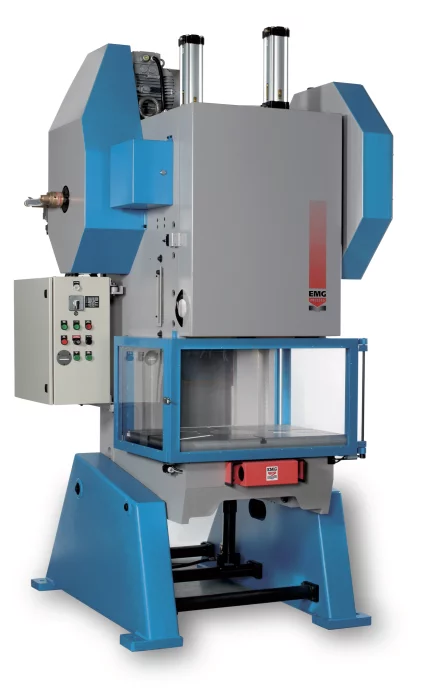
From 6 to 80 tonnes, EMG's range of mechanical presses is built for one purpose: high-volume (Up to 240 strokes/min), high-precision metal forming that keeps running, whit unfailing reliability, shift after shift, without compromise.
Engineered with welded high-strength steel frames, forged eccentric shafts, and CE-certified safety systems, EMG presses deliver the repeatability and structural rigidity that production managers, toolmakers, and quality engineers rely on. Each model in the range combines a variable stroke, adjustable daylight, and bronze-guided ram with a compact C-Frame footprint, giving you a versatile, reliable press that integrates easily into any workshop or automated line.
Five standard models (6T, 15T, 25T, 45T and 80T) cover the full spectrum of light-to-medium-duty for every application. Custom configurations and special executions are available for demanding or non-standard use cases.
Being durable, these guarantee you optimum quality and unparalleled productivity for a very long time! Furthermore, the various operations are executed carefully thanks to the power reserve of each model.
- Complies with CE standards (3 CE type approvals)
- Stroke change and adjustment of the quick release ball screw
- Robustness and reliability of the press and its components
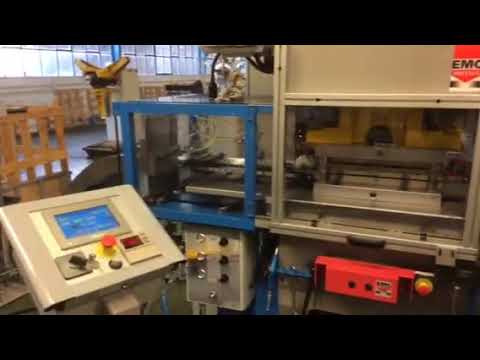
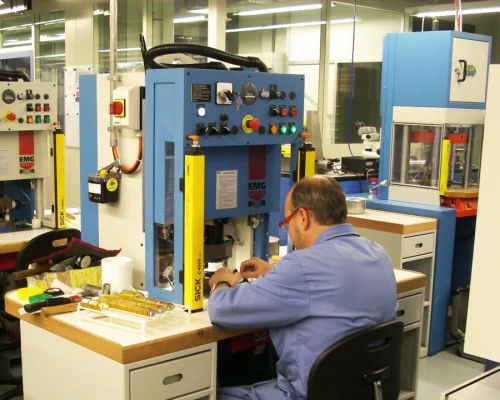
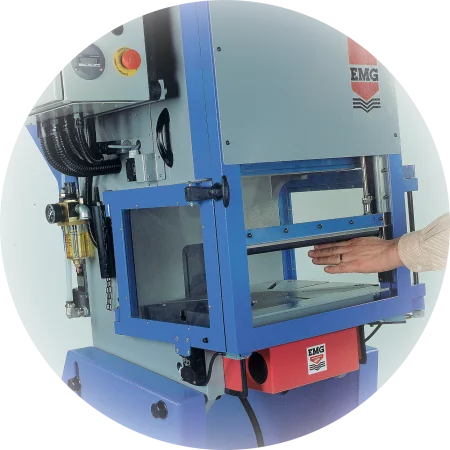
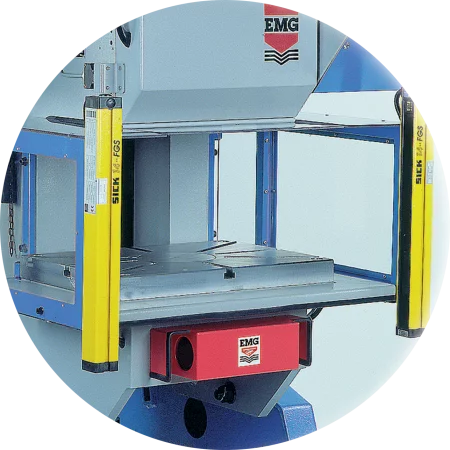
- More security to gain in productivity (screen - electronic guards)
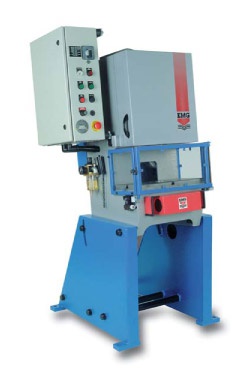
| Variable stroke4 » 40 mm |
| Swan-neck depth120 mm |
| Table dimensioning450x220x30 mm |
| Number of cycle / min240 |
| Clear height200 mm |
| Swivel screw adjustment0 » 30 mm |
| Weight450 kg |
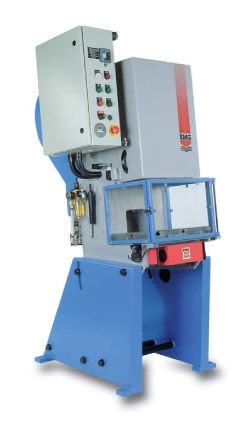
| Variable stroke5 » 75 mm |
| Swan-neck depth180 mm |
| Table dimensioning450x320x40 mm |
| Number of cycle / min140 |
| Clear height300 mm |
| Swivel screw adjustment0 » 50 mm |
| Weight900 kg |
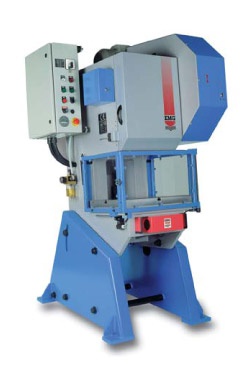
| Variable stroke5 » 75 mm |
| Swan-neck depth210 mm |
| Table dimensioning550x400x48 mm |
| Number of cycle / min140 |
| Clear height300 mm |
| Swivel screw adjustment0 » 60 mm |
| Weight1 400 kg |
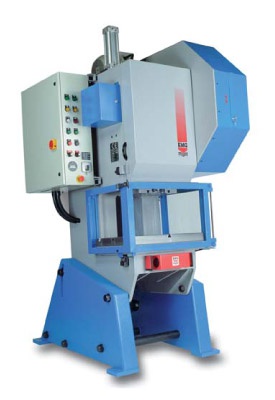
| Variable stroke6 » 100 mm |
| Swan-neck depth220 mm |
| Table dimensioning650x430x57 mm |
| Number of cycle / min130 |
| Clear height350 mm |
| Swivel screw adjustment0 » 70 mm |
| Weight3 100 kg |
| Variable stroke8 » 120 mm |
| Swan-neck depth300 mm |
| Table dimensioning850x600x67 mm |
| Number of cycle / min100 |
| Clear height400 mm |
| Swivel screw adjustment0 »90 mm |
| Weight6300 kg |
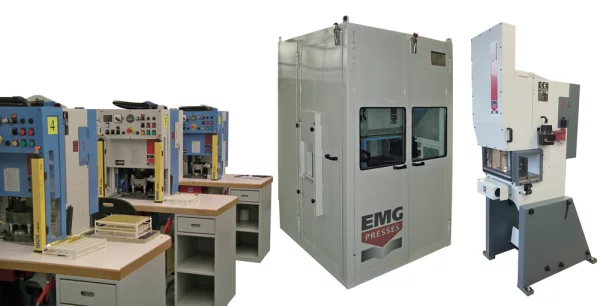
Special executions
Applications

MAIN FEATURES
Main caracteristics of an EMG mechanical press :
Frame :
The frame is made of high quality mechanized-welded steel with swan-neck structure. Regular weld seams and proper welding supports ensure an exceptional rigidity and a resistance against cutting impacts even during an intensive use.
The very thick sides of the frame reduce the swanneck opening.
Shaft :
The shaft is made of hardened forged steel. An over-sulfinization after machining reduces the wear and tear due to friction. It runs on lubricated rings.
Stroke change :
The stroke change is achieved very quickly by turning the disconnecting device a ¼” of a turn and then selecting the desired Stroke length.
Slider :
The slider is made of cast iron FGS 300 mounted on steel or bronze sliding rails, adjustable by screws. The assembly is completely adjusted and scraped manually.
The adjustment is carried out by stops mounted on the press frame.
The bedplate of the slider has holes and a central bore for fixing tools.
The sliding rails have machining in the form of "oil grooves" allowing an efficient lubrication.
A knock-out bar goes through the slider. The adjustment is carried out by a stop mounted on the frame.
Lubrification :
The lubrication is centralized and ensured by a manual pump. The frequencies are to be adapted as per the cycles used (single or continuous stroke working).
Automatic pump (optional).
Twin-body solenoid valve :
It is self-controlled and assembled with heavy duty silencers.
Connecting rod/Swivel screw :
The connecting rod is made of FGS 300 cast iron (steel on 80T) with bronze line completely scraped ensuring a perfect lubrication. It is lubricated by oil.
The swivel screw is made of pre-treated steel, completed by a surface treatment.
Clutch/Brake :
The movements of the press are obtained by a monodisc air clutch and managed by a brake. An air reservoir compensates for the possible failures of the network starting from the 25t model.
Standard Equipment
-
Two hand controls with push buttons.
-
Central greasing by manual pump
-
6 digit counter with reset function, 8 digit counter without reset function
-
Single or continuous stroke
-
20° inclinable frame (option 45t and 80t)
-
Regulation with or without motor
-
Positive ejector in the slider
-
Balancing cylinders (45t and 80t)
-
Slider hydraulic unblocking (45t and 80t)
-
Automatic unblocking for the stroke adjustment (80t)
-
EC compliance certificate
-
User manual and electrical, pneumatic and hydraulic diagrams
-
Periodical verification guide (regulatory follow-up, verification procedures, preventive maintenance, faults and remedies)
APPLICATIONS
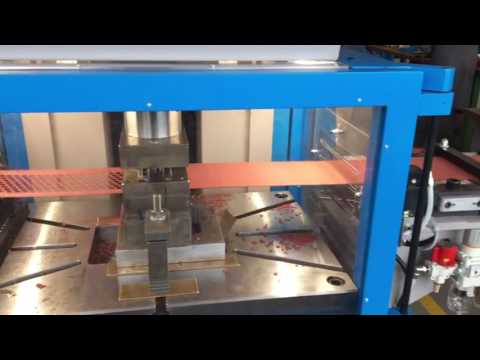
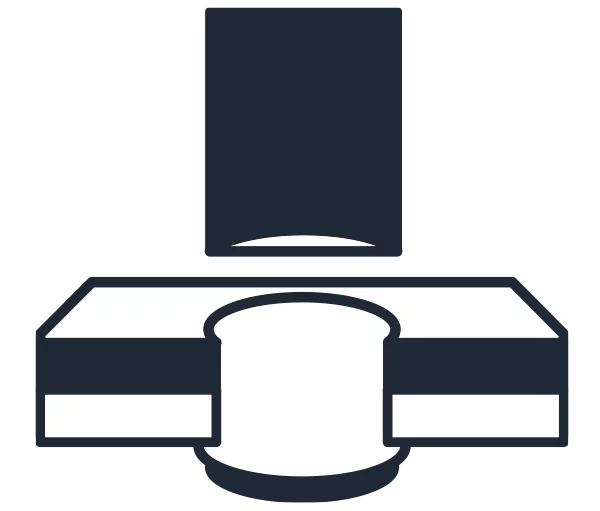
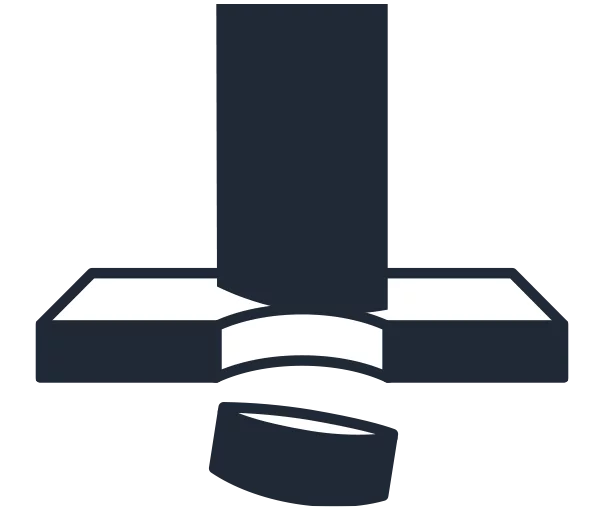
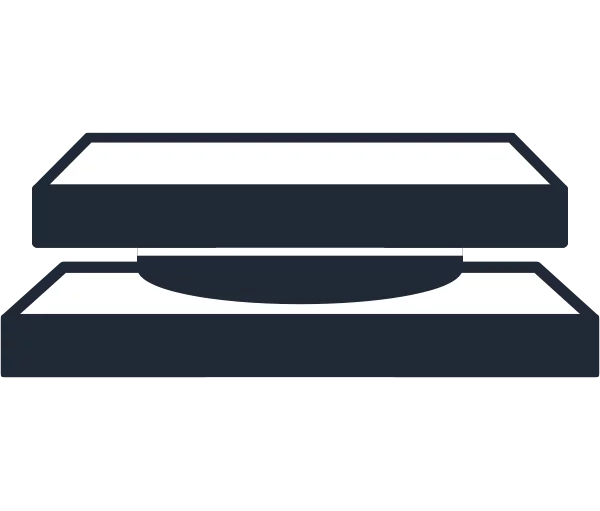
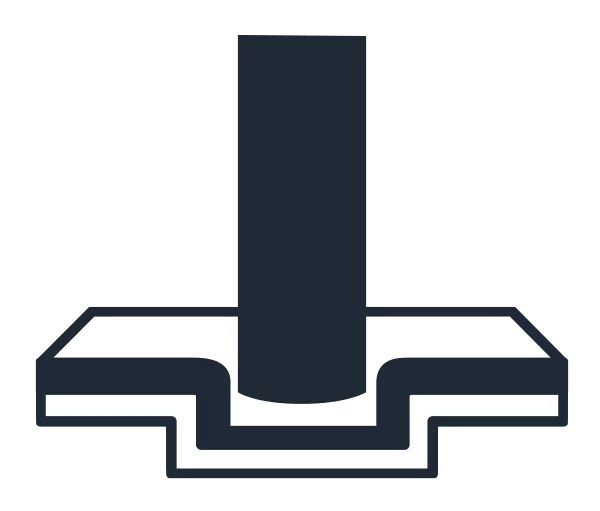
EMG has developed a range of mechanical presses from 6 tons to large tonnages (80 tons) particularly adapted to the stamping of all types of sheets. They are also adapted to the cutting/forming of complex parts thanks to the easy management of the force and the control of the pressure exerted throughout the operation.
How does a EMG mechanical press work?
Mechanical vs. Hydraulic vs. Servo Presses: Why Choose Mechanical?
Choosing the right press technology is a capital decision with long-term consequences on productivity, maintenance costs, and total cost of ownership. Here is an objective comparison to help you decide:
EMG mechanical eccentric presses are faster than hydraulic presses and offer very high repeatability with a low risk of breakdown, thanks to a mechanically simple drivetrain with no hydraulic seals to fail, no fluid to contaminate, and no pump curves to manage. For high-volume blanking, punching, stamping, and assembly, they are the default choice in most production environments worldwide. Our range of standard mechanical presses offers speeds of up to 240 strokes per minute (6 tonnes) and 100 strokes per minute (80 tonnes).
Hydraulic presses offer greater flexibility (full rated force at any point of the stroke, programmable dwell time, and adjustable stroke length) making them the right tool for deep drawing, hydroforming, and forming complex geometries. But this flexibility comes at the cost of speed, more intensive maintenance, and higher long-term running costs.
Servo-mechanical presses offer a fully programmable stroke profile and outstanding energy efficiency for demanding applications such as fine blanking or forming advanced high-strength steels (AHSS). However, their capital cost is substantially higher (typically three to five times that of an equivalent mechanical press) which makes them a specialist investment, not a general-purpose choice.
C-Frame (Gooseneck) Architecture: Open Access, Compact Footprint
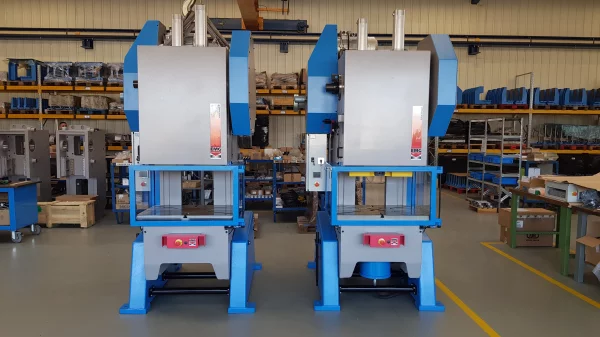
All EMG mechanical eccentric presses feature a C-Frame (gooseneck) architecture, the most widely used configuration for workshop and production-line metal forming. The defining advantage is unrestricted access on three sides of the working area (front, left, and right), which simplifies manual loading, coil-fed strip feeding, and robotic integration without requiring complex guarding architectures.
EMG C-presses are fabricated from mechanically welded high-quality steel. Consistent, full-penetration weld beads and generous weld material ensure exceptional rigidity and resistance to the impact shocks generated by blanking and stamping, even under sustained intensive use. The thick side walls limit gooseneck opening under load (the inherent trade-off of single-column architecture) while conservative tonnage ratings keep working loads within the elastic range of the structure.
- Quick stroke change by declutching : no tools required, no downtime.
- Adjustable gib guides in hardened steel or bronze, ground and hand-scraped, for consistent ram alignment throughout tool life.
- Tiltable bed to 20° on 45T and 80T models : facilitates gravity ejection of blanked parts without a separate conveyor.
- Positive ejector rod through the ram with adjustable stop on the frame : standard on all models.
- Hydraulic ram unlocking (45T and 80T) and automatic stroke-change declutching (80T) for rapid reconfiguration.
Applications: What Can EMG Mechanical Presses Do?
To explore our complete range of industrial press,
discover our main press machine catalog. For constant and linear power during manual assembly tasks, a rack and pinion press provides reliable operation up to 5000kg. If your application requires maximum force precisely at the end of the stroke for crimping or fine cutting, a manual toggle press is the ideal solution. For environments requiring higher output rates and adjustable air-driven force up to 6000kg, a Pneumatic press delivers fast and precise cycles. For heavy-duty tasks needing up to 100 tonnes of smooth, shockless force, explore our hydro pneumatic press range. Finally, for part identification, numbering, or riveting applications requiring consistent striking power, an impact press machine ensures perfect repeatability with its built-in double-strike prevention device.
Request a Quote or a Trial Run
Our engineering team will assess your application, recommend the right tonnage and configuration, and provide a full technical proposal including cycle analysis, tooling recommendations, and layout drawings.
- Request a PDF data sheet for any model in the range.
- Request a formal quotation with delivery, installation, and commissioning details.
- Request a trial run, test your own tooling on an EMG press before committing.
Special executions are available on request.
Blog