Assembling
Assembly is a fundamental manufacturing technique that creates a mechanical connection between several parts (metals, plastics, alloys or composites) to form a coherent whole. The resulting joint can be elastic or rigid, articulated or fixed, permanent or removable. Unlike welding, assembly allows parts to be disassembled while maintaining very high connection strength, making it a preferred process across countless industrial sectors.
It is possible to mechanically assemble different shapes and sizes of parts with a manual, pneumatic or hydropneumatic press. Whatever the range required for your application, your press gives you permanent, optimal quality control, production monitoring and total control of your manufacturing process.
What Is an Assembly Press?
An assembly press is a machine tool designed to apply a controlled force that inserts, crimps or secures components to one another. It creates a mechanical bond using specific tooling composed of two elements:
- the lower part, fixed on the table of the press, which receives and positions the workpiece;
- the upper part (punch), which positions and drives the element to be assembled.
These two parts are generally guided to ensure perfect alignment and a quality assembly, free of any lateral deviation that could damage the parts or compromise the strength of the joint.
What is expected from an assembly press?
- Absolute precision in guiding to guarantee perfect alignment of parts.
- Perfect repeatability of the applied force to ensure consistent quality across the entire production run.
- Adaptability to varying production volumes — from one-off prototypes to high-volume series.
- Optimal ergonomics to prevent musculoskeletal disorders (MSDs) in operators.
- Advanced safety systems: light curtains, two-hand controls, CE-certified guarding.
- Possibility of adding force and displacement sensors for 100% in-line quality monitoring.
- Full automation of the process enables continuous monitoring, detecting any anomalies quickly.
EMG Assembly Press Technologies
EMG offers three complementary press technologies for assembly applications. The choice between them depends on the required force, the production volume and the level of automation needed.
Manual Presses (Rack & Toggle) — Sensitivity and Control for Small Series
 |
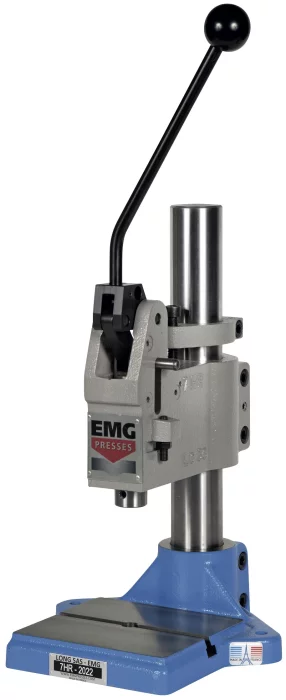 |
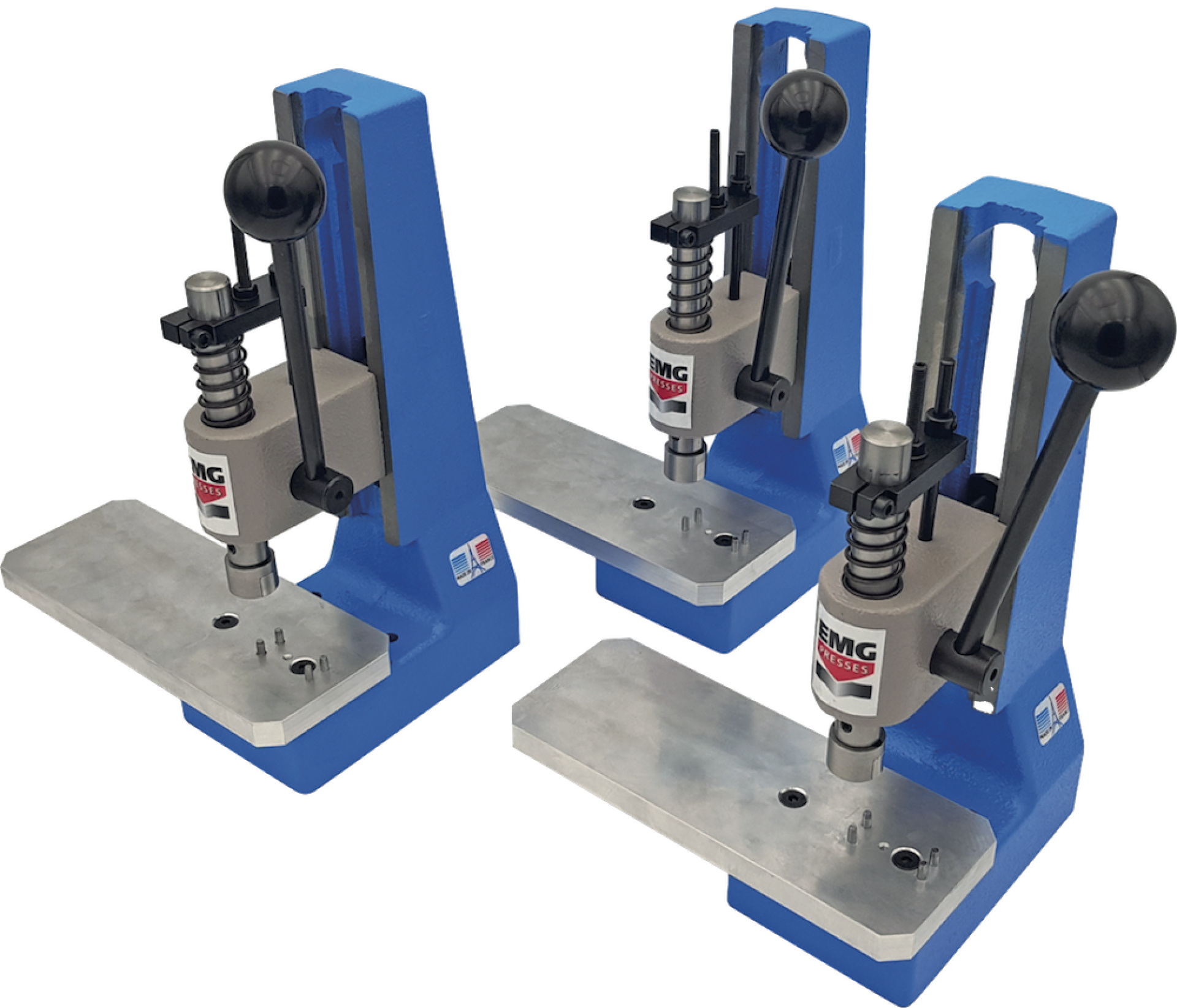
Manual presses use the operator's muscular force, amplified by a rack-and-pinion or toggle mechanism.
They offer direct haptic feedback, allowing the operator to physically 'feel' the assembly operation and detect any resistance anomaly in real time.
The EMG range of manual presses covers two distinct mechanisms with their equipment:
|
Rack-and-pinion mechanism
|
Constant linear force over the entire stroke. Power ranges from 200 to 5000 kg depending on model. Ideal for deep assemblies or operations requiring a long stroke, such as inserting guide rings or threaded inserts. |
|
Toggle mechanism
|
Maximum force delivered at the very end of the stroke. Power from 500 to 2000 kg. Perfect for crimping or riveting operations that demand peak force at the final moment. |
|
Anti-return system
|
Prevents the lever from rising if end of travel is not reached ; guarantees complete and reproducible execution of every operation. |
|
Force & displacement management
|
EMG offers transducer solutions for 100% part control, available across the full range. |
All EMG manual bench presses are manufactured in France, ISO 9001 certified since 2000, and delivered with a service manual, CE conformity certificate, drawings and a full one-year parts, labour and travel warranty.
Best suited for: Prototypes, small and medium series (up to ~500 parts/day), delicate assemblies, bearing mounting, laboratory and workshop use.
Pneumatic & Hydropneumatic Presses — Productivity and Power for Large Series
  |
|
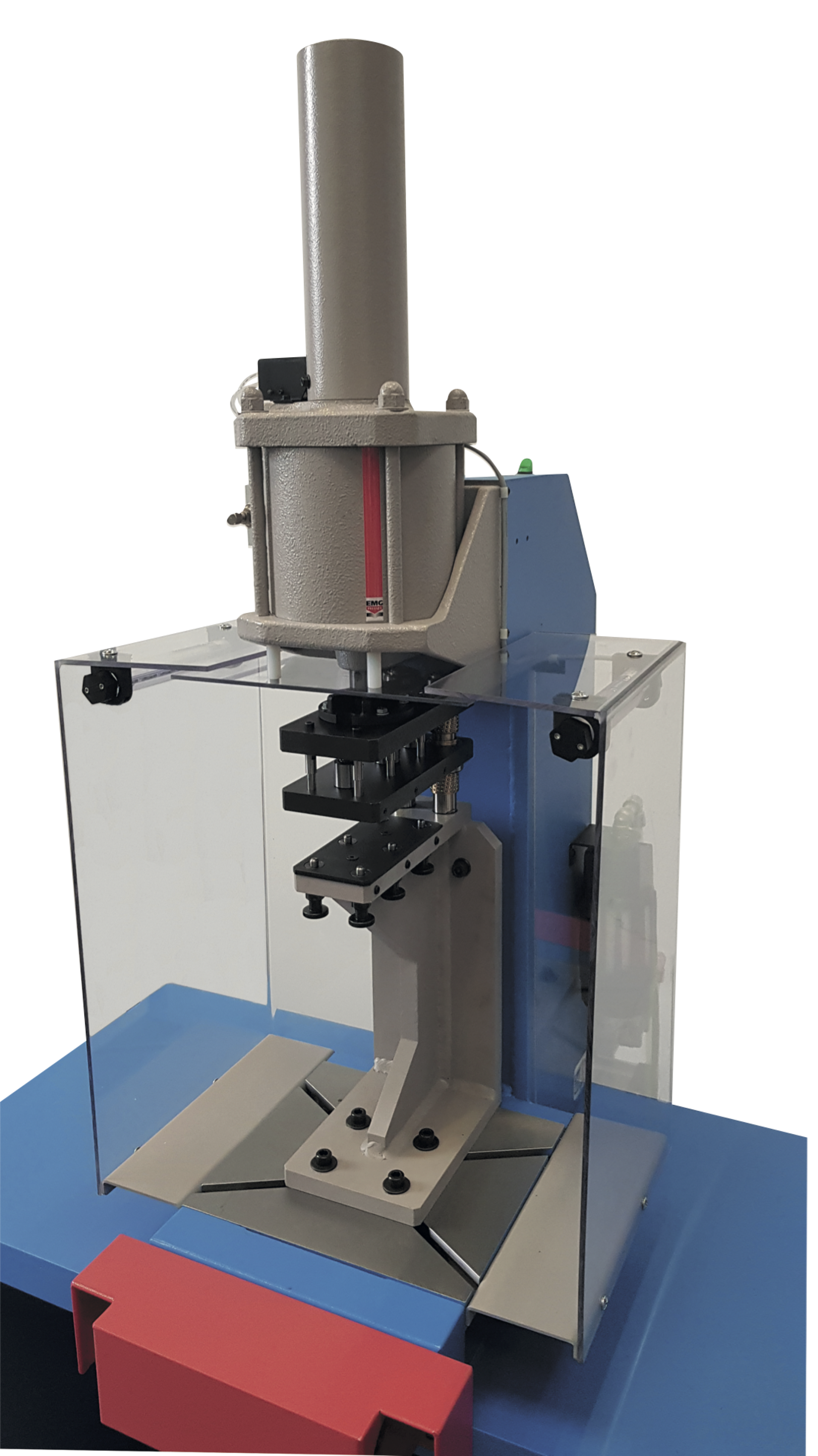
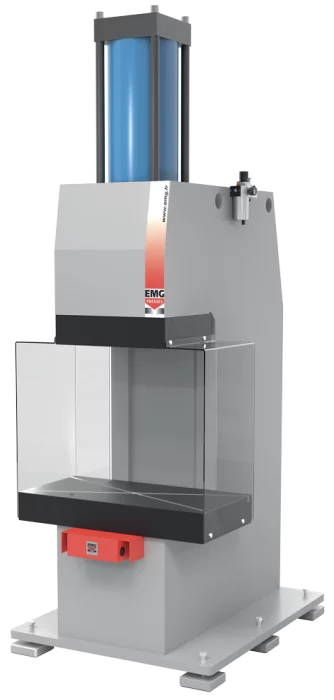
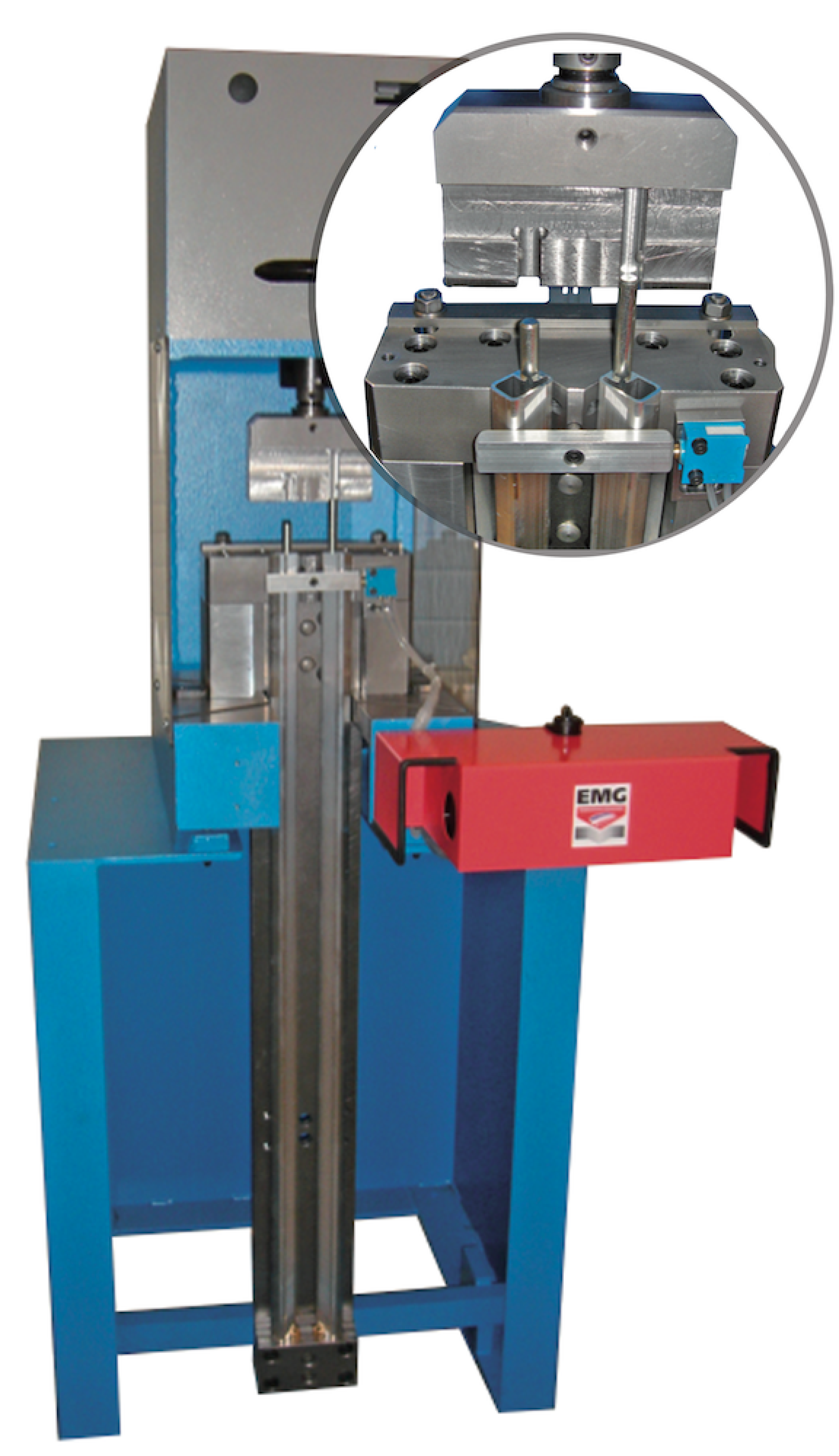
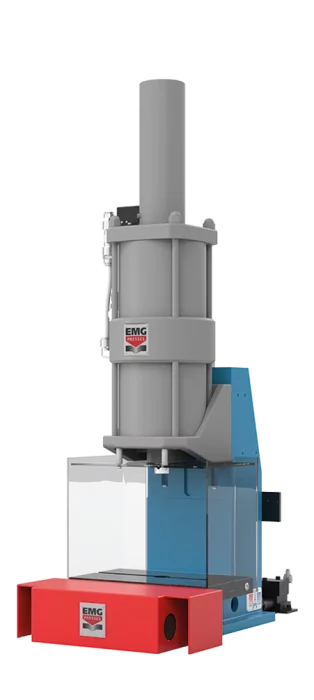
When production volumes exceed 500 parts per day, or when the required force surpasses the capabilities of manual presses, pneumatic and hydropneumatic presses become the technology of choice. They use compressed air energy (pneumatic) or a combined air/oil circuit (hydropneumatic) to generate the pressing force, completely independent of the operator.
The EMG pneumatic range completes the manual range by perfectly meeting user requirements when output is higher and/or power to be delivered is greater. All cylinders are EMG-manufactured and have proven themselves in thousands of applications worldwide. The slide is made of chrome steel, guided on bushings and secured against rotation by a key, ensuring perfect guidance under load.
|
Force range
|
Pneumatic: proportionally adjustable from 44 to 87 psi. Hydropneumatic: up to several hundred kN for heavy press-fits. |
|
Cycle automation
|
Repeatable cycles at high cadences ; consistent output regardless of operator. |
|
Complementary automation
|
Sub-systems such as rivet feeding can be automated when assembly is performed by riveting. |
| Ergonomics & safety | Reduced operator fatigue, prevention of MSDs, integrated protections, adjustable lowering speed for added comfort. |
|
Traceability
|
Integration of force/displacement sensors for 100% process monitoring and quality reporting. Full automation of the process enables continuous monitoring, detecting any anomalies quickly. |
The EMG pneumatic and hydropneumatic range can be integrated directly into the workstation or production line, providing ergonomics, operator safety and process reliability. EMG can also design and equip the entire workstation around the press: lighting, workpiece support, ergonomic PC shelves and power reduction systems for low operator effort.
Best suited for: Large series production, force press-fitting, automated production lines, automotive and aeronautical assembly.
Why Choose EMG for Your Assembly Press?
EMG Presses, trading as ETS LONG SAS, has been designing and manufacturing manual, pneumatic and hydropneumatic presses in France since 1950. ISO 9001 certified since 2000, the company operates a fleet of over 40 machining centres and a dedicated technical and testing centre at its facility in Marigny-Saint-Marcel, Haute-Savoie.
| Force & displacement monitoring | EMG offers all types of force and displacement sensor solutions, with transducer solutions to suit every need for both manual and pneumatic presses ; enabling 100% in-line part control and full traceability. |
| Certified safety | Integration of light curtains and two-hand controls conforming to CE / Machinery Directive requirements across the range. |
| Custom engineering | In-house design office capable of developing specific tooling and fully bespoke special presses for any application ; offset toggles, multi-rivet crimping tools, integrated ejection systems and more. |
| Durability & surface treatment | Zinc-plating, nickel-plating and other surface treatments available. Robust frame construction to prevent any deformation under rated load. |
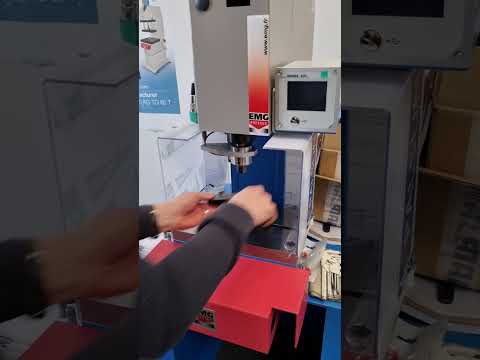
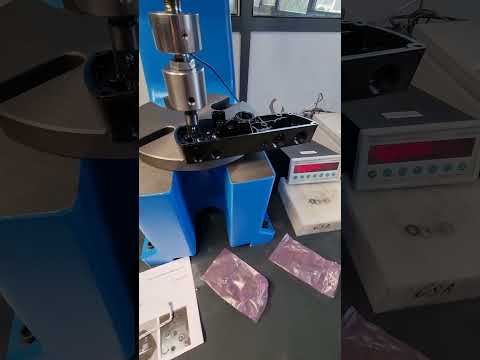
| Test centre | Customers are welcome to bring sample parts for process validation and press selection ; tests conducted in EMG's laboratory and showroom adjacent to its manufacturing workshops. |
Assemblig test centre
Industrial Assembly Applications
Assembly by press covers an immense spectrum of industrial applications, from precision watchmaking to heavy mechanics. EMG presses are used daily in the following operations:
- Ball bearing mounting : Assembly of ball bearings
Precise insertion into bores without damaging the cage or inner ring — critical for any rotating assembly.
- Guide ring assembly : Assembly of guide rings
Interference fit to guarantee concentricity and optimal guidance.
- Threaded insert installation : Mounting of threaded or tapped inserts
Permanent fixing into soft materials, sheet metals or thermoplastics.
- Steel-cage seal fitting : Assembly of seals with steel cage
Flush, leak-free installation of shaft seals and O-ring assemblies.
- Pin press-fitting : Pin assemblies (chassage)
Secure mechanical connection by force insertion of roll pins, dowel pins and spring pins.
- Spring assembly under load : Installation of springs under stress
Compression and retention of the spring while the assembly is secured — screw fixing and controlled release of tension.
- Gearwheel mounting : Installation of gearwheels on an axle
Shrink-fit or keyed assembly requiring precise axial thrust force without impact.
Industrial sectors served
Automotive (engines, gearboxes, suspension), Aeronautics (structural parts, ring/plug fitting in high-pressure assemblies), Household appliances, General industry and mechanics, Laboratory and R&D environments, Food processing and pharmaceutical (316L stainless steel versions available).
Designed for a complete range of assembly presses
With correctly adjusted tooling, force is delivered with precision throughout the stroke, ensuring quality assembly at every cycle.
Squareness ensures press stability and precision. Integrated design and production, combined with solid technological expertise, enable our teams to produce presses that meet the expectations of our industrial customers.
Our teams are on hand to provide you with the assembly press best suited to your needs, based on :
- Part or tool size criteria,
- power requirements
- health and safety constraints,
and respect for your environment.
Whether for standard versions or special designs, combining versatility and precision, EMG presses can be used to carry out a wide range of assembly, stamping, cutting, riveting, bending and marking operations. With our advice, get the most out of our presses to optimise your production processes.
Frequently Asked Questions
Which press should I choose to assemble bearings?
For occasional bearing mounting or small series (up to ~500 units/day), a manual rack-and-pinion or toggle press with appropriate tooling is the most cost-effective and tactile solution. For larger volumes requiring consistent repeatability without operator fatigue, a pneumatic bench press with force monitoring is the preferred choice. EMG's technical and testing centre can validate the correct press type and force range on your actual sample parts before any investment.
How do I avoid MSDs during manual assembly?
EMG manual presses feature ergonomic levers with adjustable length, spring-loaded return systems and mechanical end-stops that guarantee complete, reproducible execution of every operation. For higher cadences, switching to a pneumatic press further reduces operator effort and repetitive strain, as the compressed-air cylinder does the work. Integrating force sensors also eliminates the need for the operator to judge force by feel alone.
What is the difference between a pneumatic and a hydropneumatic press for assembly?
A pneumatic press uses compressed air directly to drive the piston, offering fast cycles and forces typically up to a few tonnes, well suited to the majority of assembly applications. A hydropneumatic press combines a compressed-air cylinder with a closed hydraulic circuit: air provides speed, while the oil multiplier delivers significantly higher forces (up to 100 tonnes and beyond) with low noise and economical energy consumption. Hydropneumatic presses are the choice for heavy press-fitting, large interference-fit assemblies and applications requiring precise, high-force control at the end of stroke.